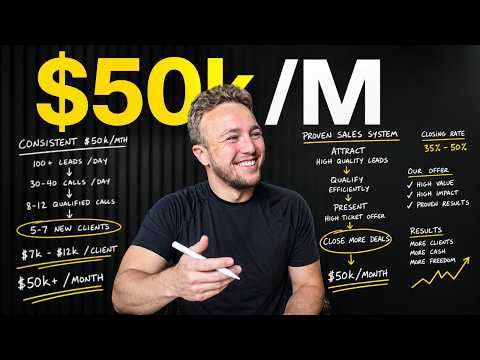
Here's what actually separates $5k vs $50k closers
Most reps think $50k months come from better closing. Wrong. It's the whole system, on the call, off the call, and your whole life.
Short answer
What actually separates a $5k closer from a $50k closer?
It's not one skill, it's the whole system. A $5k closer is a hammer following a script. A $50k closer is a lock pick, optimized on the call, outside the call, and in lifestyle. That means authority, understanding human behavior, tracking data, referrals, plus sleep, focus, biology, and environment. Fix one area at a time, in order.
Watch the full video: Here's What Actually Separates $5k vs $50k Sales Reps (copy this) (1:11:41)
Most reps think the gap between $5k months and $50k months is just getting better at sales. Better discovery, better objections, better closing. That's part of it. But the $50k closer isn't just better on calls. They're optimized in every single area of their life. And nobody talks about that part.
I've sold $9M+ in sales across multiple industries with a 90% close rate. I've trained six, seven, and eight figure sales teams. I've helped reps go from dead broke to 50k, 60k, 70k a month. So let me break down the actual difference across three areas. On the call. Outside the call but still sales related. And lifestyle.
Every prospect is a lock, not a nail
Here's how I think about it. Every person you talk to is a lock. Your job is to help them unlock whatever is in their head that gets them to move forward.
"Most 5K per month closers, they're just a hammer. They're following a script. They fall into people's frames."
A hammer works on a lock sometimes. But if it's a good lock, you're screwed. A $5k closer closes maybe 10 to 20% of their calls because they're hoping the hammer works. A $50k closer is a lock pick. They connect, they lead, and they close 45 to 75% plus because they come across genuine and they're consistent in sales and in life.
Turning a hammer into a lock pick is a systematic process. Most people try to fix everything at once and end up fixing nothing. You need to hit the lowest hanging fruit first so you only see increases, not a rollercoaster.
What happens on the call
The order I teach isn't the order you learn in. It's the order that gets you the fastest wins without wrecking your confidence.
Authority first. People are wired to obey authority, it's basic human instinct. A $5k closer gets bulldozed, seems unsure, lets the prospect think they know more than the rep does. A $50k closer stays calm, confident, and in complete control of the conversation.
Understand human behavior. Every person on a sales call has a need that isn't being met.
"People who are perfectly content in life do not hop on sales calls. So if you're talking to somebody and they're telling you they don't have a problem, they're lying to you."
See people as reasons, not problems to fix. Everyone thinks they're the hero of their own story. If you see people as reasons instead of trying to fix them, you talk to them with empathy instead of judgment, and you close more.
Open the call right. Get them open and focused in the first two to three minutes. Don't let them ramble. How someone talks is how they think, so a scattered opener means a scattered close.
Presentation under 10 minutes. Tie off value before price every time. Ask, "Before we get into the investment, do you feel like with what we covered this would get you from where you are to your goal?" If yes, you've removed two of the three objections (time, money, value) before they even show up.
Future pace with specifics. Vague goals don't move people. Get specific, tangible, emotional outcomes and a moment in time they can picture. I always say, your mind doesn't know the difference between an imagined memory and a real one. That's why painting the moment works.
Consequence questions. This is my favorite question in the whole call because it's where the sale actually gets made.
"That's where the sale is made. That's where the urgency is created."
A good consequence answer isn't about the words, it's about the emotion. I had a guy go dead silent, holding back tears, and barely squeak out "it's not going to be good." That's an elite answer.
Objections, problem, pre-handling, identity. Memorize your top three objections front to back. Get people to admit the problem is real and it's their fault, because if it's not their fault, nothing you say can help them. Turn external excuses ("I don't have time") into internal beliefs ("I'm not willing to make time"). Then dial in identity selling, asking what happens if this person stays exactly the same forever. That question should hit like a truck.
Outside the call, still sales related
This is where most reps leave money sitting on the floor.
- Track your show rate, one call close rate, follow up rate, top objections, and slot utilization. Make decisions off data, not feelings.
- Optimize your calendar so you happen to the day instead of the day happening to you.
- Ask for a referral after every single sale. Referrals are free money and they close higher.
- Build a customized pre-call process to indoctrinate people before they show up. Generic automated stuff gets ignored.
- Send text and email blasts every week. A simple no sale blast offering a payment plan can revive dead leads fast.
- Seed the upsell on every close and book a 21 day check-in to ask for referrals and upsell again.
"You should be the most skilled person on your team and do the most activity on your team. If you do both, that's how you can hit 50k plus per month."
Build a relationship with your setters too. They directly control how much money you can make. Train them, help them, and when it's working, ask for favors like extra comms for hot leads.
Lifestyle is not optional
This is the part nobody wants to hear.
Sleep. A $5k closer has inconsistent sleep and inconsistent energy. A $50k closer wakes up and goes to bed at the same time every day, gets sunlight early, and keeps the bedroom dark and quiet. You cannot outwork terrible sleep.
Focus and state. You're a mental athlete. You only get paid when you close people.
"There are trillion dollar companies that are fighting for your focus. Social media, YouTube, what you're watching right now."
Biology. Eat single ingredient foods most of the time, move daily, get sunlight. This isn't about getting shredded. I've done bodybuilding shows and felt like garbage the whole time. The goal is performance, not vanity.
Time management. Outsource anything below your hourly rate. Cleaning, cooking, laundry. I pay a housekeeper and my wife cooks, because every hour I spend on low value tasks is an hour I'm not making money or recovering.
Environment. Your setup either works for you or against you. I moved from Kansas to Miami Beach as a 21 year old the second I started making money, just to get away from people who'd steal my attention.
Visualization. Rewrite every call that didn't close, in your head, as a win. Your body gets addicted to certain emotions based on how you grew up. You can give yourself permission to feel confident instead of waiting for the outside world to hand it to you.
Work capacity. If you want balance later, it usually takes a season of total unbalance first.
"It is going to take a season of you working 40, 50, 60, 70 hours per week to get to the point where you can have so much skill that you can cut it down to 20 hours per week and make 30K."
Financial freedom. Making the money isn't the finish line. You need an actual plan for what you do with it so sales is a stepping stone, not a life sentence.
The bottom line
Going from $5k to $50k is not about learning one more closing line. It's a systematic rebuild of your calls, your sales habits off the call, and your entire life. Pick one area at a time. Hit your KPIs, then move to the next one. Do it in order and you will only raise your income, never lower it.

Written by Christian Polk
Christian Polk is a high ticket closer, sales trainer and the founder of Precision Closer, based in Scottsdale, Arizona.
More about me