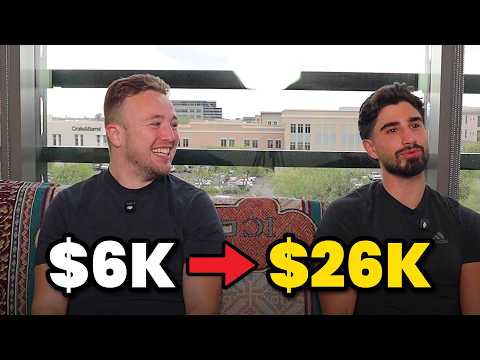
How Jonathan went from $8k to $31k a month as a closer
My client Jonathan was stuck under $8k a month closing for gym owners. Now he hits $31k with fewer calls. Here is exactly what changed.
Short answer
How did Jonathan go from $8k to $31k a month closing sales?
I helped my client Jonathan go from under $8k to $31k a month on the same offer, same niche. The real shift wasn't a script. He stopped playing a character and showed up as himself, pushed discovery from 20% to 35% of the call, and surfaced objections early so they became simple logistics instead of fights.
Watch the full video: How Jonathan Makes $31,000/m As A Closer (42:14)
I sat down with my client Jonathan a few weeks back. Before we worked together he was making under $8,000 a month in commissions. Last month, selling the exact same offer, taking fewer calls, he hit $31,000. Same product. Same niche. Completely different closer.
Success leaves clues. So let me break down exactly what changed for him, because none of it was some secret script. It was deeper than that.
He was playing a character, not being himself
Jonathan used to be a gym owner. He built his gym to a $50k a month award level, top 1% in his niche. Then he sold it and went full time selling for the company he now works for, coaching and tech for gym owners.
The problem was, he never actually became the new version of himself. He was still trying to lean on "gym owner Jonathan" instead of stepping into what he calls Jonathan 4.0, the sales professional.
On calls he was nervous. He had just sold his gym, had two little kids, no safety net, commission only. That fear showed up every time he opened his mouth.
"I had never stepped into Jonathan 4.0, which is the sales professional. I was still showing up as gym owner Jonathan."
Here's the line that hit me hardest in this whole conversation. We were talking about why he used to come home exhausted and drained after calls, and why that changed.
"You're playing a character, dude."
That's it. That's the whole thing. When you're faking confidence, faking certainty, pretending to be someone you're not on a call, it drains you in a way real conversation never will. Jonathan told me he's had more energy in sales the past six months than ever in his life, and it's because he stopped performing and started just being Jonathan.
Discovery went from 20% to 35% of the call
This is the tactical shift, and it matters.
Jonathan used to run calls like this: quick discovery, long drawn out presentation, then scramble to close. Something like 20% discovery, 60% presentation, 20% close.
After we worked together it flipped. Now he runs closer to 35% discovery, 30% presentation, 25% close.
Why does that matter? Because if you do discovery right, you pre frame and pre close objections before they ever come up. You already know what they need, so your presentation is built around their actual problem instead of a generic pitch.
"If you Discovery right, you're going to pre frame and pre close objections. You're going to understand a lot more about what they really need."
The question he leaned on hardest, the one he pulled straight from running his own gym, was simple:
"What made you want to reach out today?"
That's an internal question. It's not "what's your biggest challenge." It's digging into why they personally decided, on their own, to spend 45 minutes to an hour of their time on this call. If someone's willing to give you that time, something already moved inside them. Your job in discovery is to find that and pull it out.
The real objection is never the objection
Jonathan used to get hit with the classics. Not sure it'll work. I can figure this out myself. Pricing objections. I'll think about it.
Here's the breakdown we got into, and I think this is the most useful part of the whole call for anyone stuck closing $10k to $20k months.
"I think the reason most people don't buy, if you wanted to put a phrase with it, is normally because they're not sure it's going to work."
That uncertainty isn't really about your product. It's about whether they trust themselves to follow through, and whether they trust you. Jonathan figured out that when a gym owner says "I think I can figure this out myself," that's not a compliment to their own ability. It's a lack of trust in the salesperson.
"If they think they can do it on their own, that's because they don't trust you. You're the person conveying what you can do, and if they're like, yeah I think I can do this on my own, they're basically saying this person has no clue what they're talking about."
So the fix isn't a slicker rebuttal. It's getting someone internal. Getting them to admit the real problem is theirs to solve, not the economy, not the market, not bad luck. Once that clicks, the fear of "what if it doesn't work" gets replaced by something stronger: the fear of staying stuck.
- Pain that doesn't change is just maintenance, not progress
- Most problems get worse over time if left alone, they don't just sit still
- Rent, labor costs, competition, all of it keeps squeezing a gym owner who does nothing different
Jonathan put it plainly when he talked about a call last month with a guy who'd been stuck for ten years straight.
"Your kids don't deserve this, man. It's year eleven. Let's do something about it."
That only works if you've earned the right to say it. Which brings me to the next piece.
Get everything out in front, then closing stops feeling like closing
Jonathan told me something that stuck with me. He used to dread objections because he had to go find a way around them. Now he barely gets real objections anymore, because he surfaces everything on the call before it becomes a problem.
He asks direct questions early. What software do you use right now? What was your experience like with that other company? What's your revenue, are you in the black or the red? He's not afraid to get specific, because specifics build trust.
"It's easier to object when someone's objecting with something they don't think you know anything about. But when you say, hey, you told me you guys profit six grand a month, it's laid out on the table. It's not a thing."
Once that trust is built, what used to look like objections turn into logistics. A recent call he had, the guy said "I don't have objections with price, I just have a few questions." How many hours a week will this take. Am I going to need to be tech savvy. That's it. Paid in full by the end.
"It's not does this strategy make sense. It's less uncertainty, less fear, less all that other stuff. It's just logistical stuff to make it make sense to their mind."
Selling the transformation, not the product
Jonathan sells coaching and tech for gyms. But he doesn't talk about websites and dashboards when he gets to the close. He talks about the person his prospect is trying to become.
"It's not the person who loses the weight, it's the person they become and keep off. That's who they really want to be. It's a shift in identity."
For a gym owner at 60 members trying to get to 150, Jonathan doesn't just quote a timeline. He says the real outcome is becoming a 150 member gym owner, someone who doesn't just hit the number but holds it and keeps building. That's the actual sale. The number is just the proof.
The numbers behind the jump
Jonathan didn't just get better at talking. He changed how he thought about volume and targets.
- He started at $2k months with wild swings, one week nothing, next week a grand
- His first real goal was consistent $4k months, about $800 a day, which felt doable
- Once $4k became normal, he pushed to $5k, then $6k, then $7k
- Now he's averaging over $6k a week with fewer total opportunities because his close rate went up
- His company raised prices twice and his close rate never dropped
"It's the mindset of deciding that 6K a week is normal. Every time we hit it, now it's seven. It slowly starts to do that."
He also told me the biggest shift in thinking came from something I say about goal setting, that visualization isn't about hype, it's about treating the outcome as already normal so you're not riding an emotional rollercoaster chasing it.
"That's how I feel about 10K a week now. I'm like, oh yeah, that's pretty reasonable."
The bottom line
Jonathan didn't need a new script. He needed to stop performing and start showing up as himself, dig deeper in discovery to find what's actually internal for the prospect, and get the real information out in front early so objections turn into simple logistics.
If you're stuck in the $7k to $25k range right now, look at your own calls the way Jonathan looked at his. Are you still playing a character on calls because you're scared to just be you. Are you spending more time pitching than you are actually understanding why someone showed up. Fix those two things and the income takes care of itself.
He went from under $8k to $31k. Same offer. Same niche. Just a different person running the calls.

Written by Christian Polk
Christian Polk is a high ticket closer, sales trainer and the founder of Precision Closer, based in Scottsdale, Arizona.
More about me