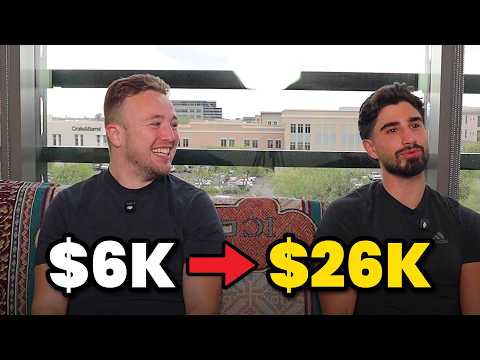
Jax went from $6k to $45k a month closing. Here is what changed
My client Jax went from $6 to 7k a month to $45k closing. No new script. Just structure, pre-handled objections, and a real offer.
Short answer
How did Jax go from $6k to $45k a month closing sales?
Jax went from 6k to 45k a month by fixing three things. He memorized his framework cold so he could actually be present on calls instead of checking notes. He started pre-handling objections in discovery before pitching, so price never felt like a grab. And he got onto an offer that could actually support bigger checks. Skill plus the right offer multiplies everything.
Watch the full video: Jax Makes $45K/Month Closing. This Is What Changed. (15:59)
I talked to my client Jax the other day. Dude went from $6 to 7k a month closing to $45,000 in commissions in a single month. Not luck. Not a new script. A few real shifts that any closer stuck in the mud can actually copy.
I've closed $9M+ in sales myself, and I run a mastermind now where I just help people get to that 0.01% of sales. Jax is one of my guys. Here's what actually changed for him.
He went from dreading calls to full state control
Jax sells career transitions into coding. Basically a biz op. Good offer, but when he first started closing, he hated it.
"The fact that I didn't want to take sales calls. And the fact that when I had calls on my calendar I'm like, I hope they don't show. I hope they don't show. I knew that was an issue."
He was closing around 20 to 22%. Not bad for a new closer, but not what he wanted. He knew it was a confidence problem, not a tactics problem. So before anything else, he had to fix how he showed up.
Now?
"10 out of 10 state control... 95% of my calls, really all of them, I'm so in the conversation. I'm not worried about the next question on my script."
That's the difference. When you don't have the structure memorized, half your brain is checking your notes. When you do, all your attention goes on the person in front of you. Their tone. Their words. The tiny shifts in how they're saying things.
Memorize the framework so you can actually listen
This is the part everybody skips. They want the "advanced" stuff before they've locked in the basics.
Jax said it straight:
"The framework is just fully memorized. With the objection handling, specifically the pre-handling objections, it's like anything you give me, I know what I need to get."
Once the structure is automatic, you're not thinking about what question comes next. You're a chameleon. You know what response you need from the prospect, you know how to ask the question to get it, and you move on. No more accepting weak answers because you didn't know what to do with them.
He told me about one of our early call reviews. He'd ask "why now, what shifted" and get a mediocre answer and just... move on. Now he doesn't accept it. He pushes until he gets something real.
Pre-handle objections before you ever talk price
This was the single biggest unlock for Jax. Not objection handling. Objection finding, and pre-handling it before the pitch even starts.
Here's why it matters, in his words:
"You've got so much more leverage. The prospect, it wouldn't be perceived like oh, you're trying to take my money now cuz there's money on the line. It comes from the standpoint that like, oh, I'm actually trying to help you."
The second you pitch and drop price, the frame shifts. Now everything you say sounds like you're chasing the sale. But if you dig up the real objections in discovery, before money is even on the table, it just sounds like you're trying to help them think clearly. Because you are.
By the time Jax gets to the end of the call, most of the heavy lifting is already done.
"If we can break down all of that at the top end and we get to the end and there might be a little bit of doubt, quickly back close. It just makes it so much simpler. You attack the beast before it gets too big."
That one line says it all. Attack the beast before it gets too big.
Stop doing five reframes when you need one shift
The second piece was what Jax calls "pointed objection handling." Before, he had no real structure for it.
"I'd receive some brief frame and I'm like, oh that's his brief frame, and then I reframe again, reframe again. And then I ask for order."
No consequence. No real commitment check. Just reframe, reframe, reframe, hope, ask. That's blind objection handling. It's exhausting and it doesn't work consistently.
Now his process is simple: reframe, consequence, get the commitment, ask for order. One real shift in their belief, not five soft ones.
"There's no point in doing five, six reframes to warm them up for 10, 15 bucks. All you need is that one shift. Okay, let's temp check. Ask for order. Cool, we're good to go."
The result? 60 to 70% of his deals now are either objectionless or pure logistics, like waiting on finance docs. That's what it looks like when discovery actually does its job.
The right offer multiplies everything else
Skill fixes close rate. The offer fixes your ceiling. Jax had both problems at once.
He was living in Southeast Asia, training for a boxing fight, closing on an offer with no financing option and a market that doesn't buy the same way the US does. After the fight, he went all in. 12 to 14 hour days, 7 days a week, moved time zones to be closer to EST, and landed on a top offer in his space where the best closer was pulling seven figures cash collected a month.
"Really having the right offer. Don't get me wrong, you're going to make a lot more money, but it gives you so much more motivation."
This matters for anyone reading this stuck at $7 to 15k. You can be the best closer in the room and still cap out if the offer doesn't have the volume or the economics to support bigger checks. Skill gets you in the door. The right offer is what lets your skill actually show up in your bank account.
How Jax got on that offer without "networking"
I asked him what came first, the networking or the skill. His answer was blunt.
"It's 50/50 in my opinion. If we don't know the person we're not going to get on, but if we don't have the skills we're not going to get on."
He didn't force connections. He met people, gave value, moved on with his life. No agenda. Then one day the sales manager from a top offer he'd met almost a year earlier reached out with an opportunity to start the next week.
The actual "interview" wasn't really an interview.
"It's not really a job interview like when can you start. I've reviewed the call. I know where you're at. I've watched your call. We've been talking over WhatsApp. It's not an interview. When can you start. It was exactly like that."
I've said this for years. Once you're good, nobody interviews you the normal way. You send a call recording. They watch it. They hire you. That's it.
"Just send sales calls. Actually show them that you're good at what you do. Don't just say you're good at what you do. Show them. Makes this hiring process so easy."
If you're trying to get on a better offer right now, stop talking about your numbers. Send the call.
The bottom line
Jax didn't find some secret script. He fixed three things. He got his structure memorized so he could actually be present on the call. He started pre-handling objections in discovery instead of waiting to fight them after the pitch. And he got himself onto an offer that could actually support the income he wanted.
His own advice to anyone stuck at 6 to 7k:
"It's not just sales. It is complete self-mastery. All aspects of life dialed in, our sleep, what we do off call, the sales training, the sales drilling. Need to be working on the low-hanging fruit."
If you're stuck right now, don't look for something complicated. Look at your structure, look at when you're finding objections, and look hard at whether your offer can even pay you what you're trying to make.

Written by Christian Polk
Christian Polk is a high ticket closer, sales trainer and the founder of Precision Closer, based in Scottsdale, Arizona.
More about me