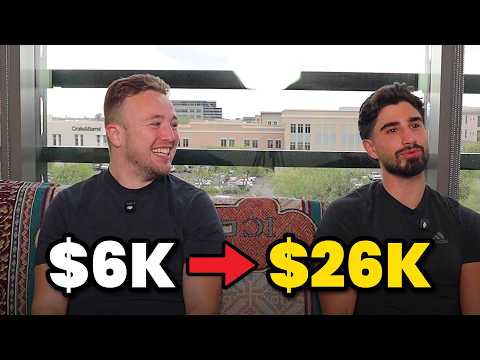
How James went from $5k to $40k a month as a high ticket closer
James used to pray prospects wouldn't show up. Now he hunts for objections. Here's exactly what changed between $5k and $40k a month.
Short answer
Why am I stuck at $7k to $25k a month as a high ticket closer?
If you're stuck between $7k and $25k a month, the gap usually isn't your close, it's whether you know why you're asking each question. James hit $40k by learning the purpose behind problem awareness, future pacing, and consequence instead of reading a script. He dug into real problems, tied identity to the decision, and chased commitment over outcome.
Watch the full video: How James Makes $40,000 Per Month As A High Ticket Closer (20:24)
I sat down with James, my first ever one on one client. He used to clear $5k a month, sometimes $8k on a good one. Now he's at $40k a month, he just had a baby, and he spent a whole month in Europe closing deals from his phone. Here's what actually changed.
He didn't have a problem finding leads, he had a problem finding problems
James found me in my YouTube comments when I had maybe 100 subscribers. He asked how he could pay me to work with him. I didn't even have a coaching program yet. That was the start.
When we started working together, James told me straight up what was broken.
"What I really struggled with before I started working with you was problem awareness. If you don't have a problem, they're not going to make a change."
He'd get into problem awareness and just bail. He said it himself.
"After problem awareness I was like, pH, I'm done with that."
He wasn't digging into impact. Not finding out what the problem was actually costing them. So the call had no weight behind it. No fire. Just surface level questions and hope.
Following a script without knowing why kills your authority
James used to sell to agency owners. These are people who already know every closing framework in existence. He'd ask a basic question and get roasted for it.
"They're like, bro, I know what you're doing. Just get to the point, like why am I here."
That's what happens when you run a script without understanding the why behind each question. The prospect clocks you as a salesperson instead of someone who can actually help them. No authority. No control of the call.
What fixed it wasn't a new script. It was understanding what he needed to get out of each part of the framework, problem awareness, future pacing, consequence. Once he knew the purpose behind every question, he could ask it a different way on the fly instead of reading off a page.
"Sales isn't like you have to follow a basic script. Sometimes you have to ask the question differently to get what you need."
Objections went from 50 caliber bullets to Nerf bullets
This is my favorite line from the whole conversation.
"Before I was getting like 50 caliber bullet objections. Now I'm getting like Nerf bullet objections."
Once James actually understood people's problems and what they wanted out of life, the objections that used to stop him cold just stopped landing. Not because he had better comeback lines. Because the conversation before the objection did the work.
He told me he used to dread sales calls completely.
"I used to hope they don't hop on the call. I just hated that feeling, like I didn't have any direction."
Now it's the opposite.
"Now I'm like, bro, hop on the call. Call the lead. Text him, make sure he shows up. Now I look forward to it."
That shift in energy changes everything about how you show up. James said he used to be conscious on the call, in his head, wondering how he was coming across. Now he just goes with it. More certain. More confident. And it shows up in the numbers, he's closing more deals and collecting more cash upfront.
The offer switch that roughly 10x'd his income overnight
James was selling two offers. When we started, he was closing for a program in the agency and bizop space, people who already knew every framework in the book. Then he moved to a new offer, still business opportunity, but selling to a different kind of buyer.
"That's almost 10x'ing my income overnight."
Here's the lesson inside that story. James was used to talking to people working a 9 to 5. The problem is obvious there. It's right in front of you. But he struggled when the people on the other end of the call were already millionaires.
"If you're a millionaire, it's like... yeah."
Finding the problem is harder when the pain isn't loud. That skill, digging past the surface to find what's actually missing even for someone who looks like they have it all, is what let him sell at a much higher level.
Identity is the real objection handling framework
James picked up something from me that he said moved the needle more than anything else, comparing who the prospect is right now to who they say they want to become.
"Right now you're the person working 9 to 5, struggling to make ends meet. Why is that? Why have you not looked for a solution?"
He said once you get good at this, objection handling almost stops feeling like handling objections.
"It's like a Nerf gun. I kind of just laugh at them now."
He pushes back on the fear directly.
"You want to become a seven figure earner, you have to start making decisions like that person. You want to keep listening to that little voice?"
That's not a script line. That's digging into identity, the bedrock of who someone is, and holding up a mirror.
Skin in the game and chasing commitment, not outcome
James brought up something I say a lot, that closers have to put more skin in the game than the prospect does.
"You got to care more about them getting their outcome than they do if you're really going to get across the line."
And the biggest shift in his mindset:
"Detach from the outcome and chase after the commitment. Once you really care about their commitment, the money just follows."
He also talked about levels of commitment, deposit, payment plan, paid in full. When someone pays in full, they show up differently. As the closer, you have to match that energy and show up with even more skin in the game than they have.
James also pointed out something most closers miss. Investing in yourself isn't optional if you're asking other people to invest in themselves.
"If you're a closer, you should always be investing in yourself, because you're asking people to invest with you. If you're not investing in yourself, you're holding yourself back, and you're leaving money on the table."
The bottom line
James didn't get to $40k a month from a new script or a magic objection handling line. He got there by understanding the why behind every question, digging into real problems instead of surface complaints, and tying identity to the decision instead of just pitching features.
He went from dreading calls to looking forward to the hardest prospects in the pipeline. That's not talent. That's reps, direction, and putting in the work he said himself, listening to call recordings on repeat at the gym.
If you're stuck in the $7k to $25k range right now, the gap probably isn't your close. It's whether you actually know why you're asking the questions you're asking.

Written by Christian Polk
Christian Polk is a high ticket closer, sales trainer and the founder of Precision Closer, based in Scottsdale, Arizona.
More about me