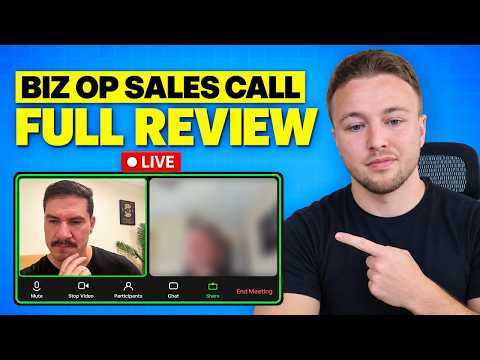
1,000 sales calls taught me how rich people really buy
Selling to poor people will make you good at sales. Selling to rich people is what actually makes you rich. Here is what changes.
Short answer
How do you sell high ticket offers to rich people?
It comes down to significance and growth, not certainty like poor buyers. I stop pedestalizing them, stop letting them minimize their problem, and ask questions that create doubt about their current plan. Then I fill that gap with authority. Nail your pre-call education so belief shifts happen before the call even starts, and look like someone who handles money.
Watch the full video: 1,000 sales calls exposed how rich people really buy (30:44)
If you want to make real money in sales, you have to get good at selling rich people. Last month I took 11 sales calls on an offer I don't even own, selling something that is not sales training, and I made over $40,000 in straight commissions. Not revenue. Commissions. This is not theory. This is what I'm doing right now.
Before I ever got into sales training, I made over $60,000 selling one high ticket $30k package as a trading algorithm. That's when it clicked for me. Selling to poor people will get you good at sales. It will not get you rich at sales. Most sales gurus only teach you how to sell to poor people. Nobody talks about the other side.
The screenshot that made me record this
A guy who owns an offer I'm on messaged me. His 12 man sales team took 1,377 Zoom calls last year and closed less than $400,000 in revenue. I've taken less than 30 sales calls on the same offer and already matched that.
"Just to show, once you dial this in, you can have less sales conversations and make more."
And it's not just me. Nathan hopped on a call, objection handled an investor with 75 properties, and closed the deal. He's on pace for $50k a month working about 5 hours a day. Three different sales coaches got canned on his offer before him because they didn't know how to sell to that demographic. Daniel smacked back a 20k deal. Abel is closing 15k deals. Another Nathan is closing 35k and 60k deals. This is a transferable skill. You can learn it.
The mistakes almost everyone makes
The number one mistake is pedestalizing the buyer. You're talking to someone who makes more money than you and something in your head says "maybe they know more than me, maybe I can't be direct with this person." Wrong move. The people making $100k to $300k a year are the most full of it and need to be called out the most. That range is just enough money to feel like you're winning while you're actually still living paycheck to paycheck with a nicer backdrop.
"They're poor people with just a better lifestyle around them."
I didn't feel financially free at $20k or $30k a month. That didn't come until I was consistently at $40k to $60k. Same thing applies to your prospects. They have the same limiting beliefs as broke people, they just have more ways to justify them.
Second mistake, falling into their frame. Every single person who hops on a sales call has a problem. Nobody who is completely content with life is booking a call with you. I think about that old Genghis Khan line about seeing himself as a plague sent by God, that if you crossed his path you messed up somewhere in your life. You don't need to take it that far, but hold that frame. They have a problem. Don't let them minimize it.
When someone says "it's not going to be the end of the world" or "I'm not going to be homeless," push back.
"Yeah, I know you're not going to be homeless. We don't talk to people who are in that situation. But I'm trying to understand, for your specific situation..."
Third mistake, letting them act like everything is obvious. "Doesn't everyone want to make more money? Doesn't everyone want to buy a business?" No. Most people never try to buy a business. Most people never try to build a facility. Call that out. Ask them directly why it matters to them.
Fourth mistake, not framing why your questions are relevant. Wealthy people are less agreeable by nature. That's actually part of why they have money, they don't just go with the flow. So when you ask a deeper question, you need a reason ready. My frame on the facility offer is simple: this needs to make business sense and personal sense, because this has to work for you not just now but five years from now.
Last mistake, not actually understanding the person in front of you. You have to know the demographic. I had never opened a sports facility before I started selling this offer. I had to learn the beliefs, the pain points, the desires of that specific buyer before I could sell to them well.
Pre-call education matters more than your pitch
The biggest edge I have on any offer is being obsessive about what people see before they ever get on my call. I can be great at handling objections, but if my pre-call education does the work for me, the call becomes easy. Two things to nail:
- What exactly are you selling
- What beliefs does this person need to hold before the call for them to be likely to buy
On my current offer, two beliefs kill deals. One, people think they have time, that the gap in the market isn't going anywhere. Two, they think they need some unique idea to succeed in business. They don't. Elon Musk didn't invent the electric car, other companies tried it first. He just executed better than everyone else. If someone shows up believing there's a real gap and that execution is what wins, they buy.
I had a client on a coaching call recently whose buyers are making $500k to $700k and want high end project management roles. One guy making $700k thought he could land a role the same easy way he always had. The market had changed and he didn't know it. The salesperson educated him live on the call and he got so hit by the belief shock that he got mad and left. That education needed to happen before the call, not during it.
Look the part or it will cost you
This part upsets broke salespeople, but I'll say it anyway. Get a haircut. Dress like you handle money. I wear a polo or a clean black shirt on calls. My apartment costs $70,000 a year and it shows in my background. I'm not saying go get a baller apartment, but your background should not look poor. A nice mic, decent lighting, a clean setup, it all plays into perception.
"If I am somebody who is making money, I don't want to give my money to a poor person, because the reason they're poor is probably because they're not good with money."
Last month I closed over 55% of my deals with 46% scheduled to close. Part of that is skill. Part of that is simply looking like someone who should be trusted with a six figure decision. When I started working with Nathan, he looked young, his haircut, his background, his voice. We fixed his facial hair, his background, and got him using a sterner voice. All of it plays a role.
Authority and doubt close the deal
You have to carry yourself like you know exactly what you're talking about. Rich people are often willing to pay someone else to shortcut their time, but only if that person actually looks and sounds like an authority. Don't fake confusion as some kind of soft sales tactic. Be confused about their specific situation if you need more info, never about your own expertise.
The biggest lever between selling to rich versus poor is doubt. You need them to realize they are out of their depth. I'll ask something simple after they mention numbers they're working with.
"How'd you get those numbers? Did you work with somebody who specializes in this?"
Every time, the look on their face says it all. "No, we just went with some rough estimate." That is the doubt you want. Yes, you're smart, but you're not an expert in this arena. That's why you're here. Doubt plus authority is what makes them write the check.
What actually makes rich people buy
Every person on a call has a need not being met to the level they want. Most reps just don't understand what that need looks like for someone with money.
I use two frameworks to think about this. First, Tony Robbins' six human needs: certainty, variety, significance, connection, love, growth, contribution. Poor buyers lean heavily on certainty and variety, can I pay my bills, I want something different. Wealthier buyers lean on significance and growth. They want to feel important, they want to do what they know they're capable of, they want legacy, they want to keep growing because their current vehicle has stalled out. Sometimes you'll hear connection and love, more time with family. Contribution comes up too, but I steer away from it. There's a reason they tell you to put your own oxygen mask on first.
Second framework, Maslow's hierarchy. Wealthier buyers already have their basic needs handled, so you're almost always working in love and belonging, and self-esteem, feeling significant, feeling like they're growing.
They are never going to say "I want to buy this because I want to feel significant." They'll say things like "I feel like I can do so much more" or "my job has been stagnant." That's your cue. Ask why it's important to them right now, then shut up and listen.
"These people have needs, believe it or not. $300,000 a year, bro. These people have needs too."
The bottom line
Selling to rich people is a different conversation, not a harder one. Stop pedestalizing them, stop letting them minimize their problem, stop letting things feel obvious, and give every question a reason. Nail your pre-call education so belief shifts happen before they ever get on the phone. Look like someone who handles money. Create doubt, then fill the gap with authority. And remember they're on the call because of significance and growth, not because they're broke and desperate. Get this right and you stop needing 1,377 calls to hit numbers a handful of good conversations can get you.
Written by Christian Polk
Christian Polk is a high ticket closer, sales trainer and the founder of Precision Closer, based in Scottsdale, Arizona.
More about me